
Snapchat has taken another meaningful step toward its long-term augmented reality vision. On January 29, 2026, Snap officially previewed shared AR experiences inside Snapchat Specs, offering a first look at how social interaction could evolve beyond phones and into immersive, wearable environments.
Rather than positioning this as a consumer product launch, Snap framed the update as a developer and ecosystem milestone — one that hints at how AR glasses could one day support real-time collaboration, co-presence, and shared digital layers in the physical world.
This preview, showcased through Snap’s EyeConnect platform, signals where social media, spatial computing, and wearable tech may be heading next.
Snap revealed these upcoming capabilities through its official EyeConnect platform, a dedicated space where the company outlines its long-term vision for augmented reality and connected experiences. According to Snap, shared AR in Specs is designed to enable multiple users to see, interact with, and respond to the same digital elements in real-world environments. The feature was previewed as part of Snap’s ongoing effort to build socially native AR systems rather than isolated, single-user experiences.
(Source: Snap EyeConnect – https://eng.snap.com/eyeconnect)
What Are Snapchat Specs?
Snapchat Specs are augmented reality glasses designed to overlay digital visuals onto the real world. Unlike VR headsets, Specs are built for seeing and interacting with your surroundings, enhanced by AR elements rather than replacing reality altogether.
Key characteristics of Specs include:
- Transparent AR displays
- Hand and gesture-based interaction
- Built-in cameras and sensors
- Integration with Snapchat’s Lens ecosystem
Specs are currently not a mass-market consumer product. They are primarily distributed to developers, creators, and partners to experiment with next-generation AR use cases.
What Snap Just Previewed: Shared AR Experiences
The latest announcement focuses on something Snap believes is essential for AR’s future: shared presence.
With this update, multiple people wearing Snapchat Specs can:
- See the same AR objects in the same physical space
- Interact with digital elements together in real time
- Experience synchronized animations, effects, and spatial content
This moves AR beyond solo filters or personal overlays and into collective experiences — closer to how people naturally socialize.
Why Shared AR Matters More Than Solo AR
Until now, most AR experiences have been individual. You point your phone, see something cool, and that’s it. The interaction usually ends there, with little sense of shared presence or continuity. Shared AR shifts this model by turning augmented content into something people experience together, making digital elements feel more like part of a real social moment than a temporary visual effect.
With shared AR:
- Digital objects gain spatial meaning
- Interactions become collaborative
- Social presence feels more natural
Snap is betting that AR becomes truly valuable when it’s social by default, not an isolated novelty.
This philosophy aligns closely with Snapchat’s core identity as a communication-first platform rather than a broadcast network.
EyeConnect: The Technology Behind the Experience
Snap’s shared AR preview is built on EyeConnect, a system that allows multiple devices to understand and synchronize a shared physical environment. By continuously mapping spatial data across users, EyeConnect ensures that digital objects remain anchored, consistent, and responsive for everyone involved. This shared understanding of space is what makes real-time collaboration in AR possible, rather than each user seeing a slightly different version of the same scene.
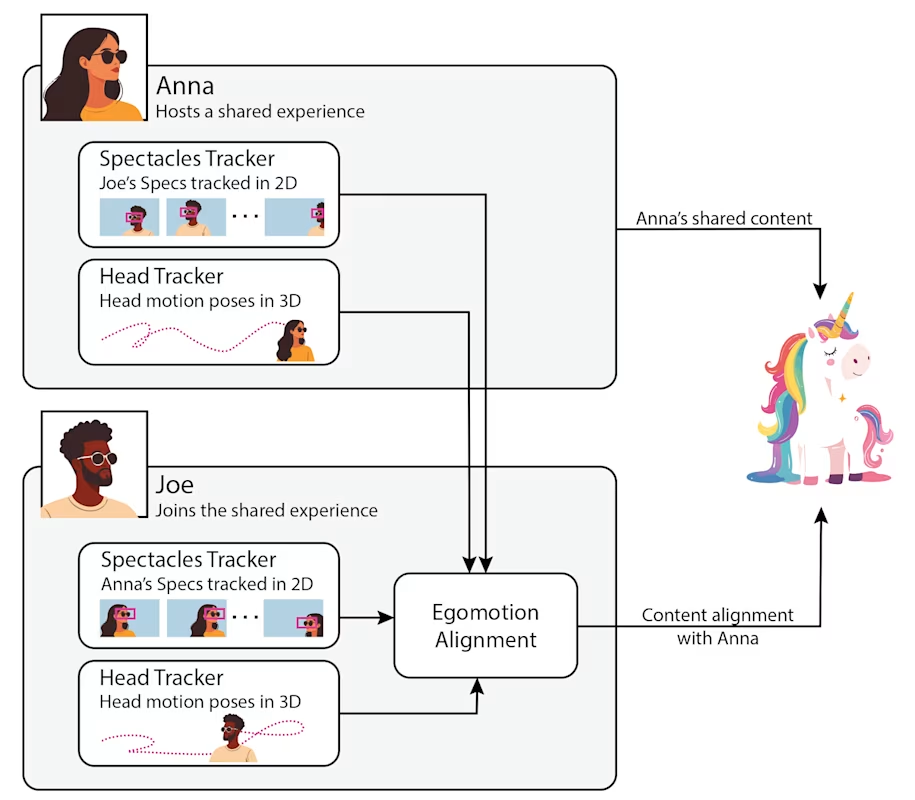
EyeConnect enables:
- Spatial mapping between users
- Real-time positional awareness
- Low-latency synchronization of AR content
In simple terms, EyeConnect helps Specs “agree” on where things exist in the real world, so everyone sees the same AR object in the same place.
This is a foundational requirement for multiplayer AR — and one of the hardest technical challenges in the space.
What Developers Can Do With Shared AR in Specs
Snap is positioning this update as a developer-first evolution. Rather than pushing shared AR as a finished consumer feature, the company is opening the tools, frameworks, and underlying systems to creators who can experiment with real-world use cases. This approach allows Snap to refine the technology through hands-on development while encouraging an ecosystem where social AR experiences are shaped organically, not dictated from the top down.
With shared AR support, creators and developers can build:
- Multiplayer AR games
- Collaborative design or drawing experiences
- Shared storytelling environments
- Location-based interactive events
This opens the door to AR experiences that feel more like activities than effects.
Snap’s long-term goal is to grow an ecosystem where AR creation becomes as common as mobile app development once was.
How This Fits Into Snap’s Bigger AR Strategy
Shared AR in Specs represents a natural extension of Snap’s long-standing investment in augmented reality, from Lenses and Lens Studio to AR-driven advertising and creator tools. Rather than treating AR as a standalone feature, Snap has consistently woven it into everyday communication on Snapchat. This latest preview suggests the company is now focused on evolving AR from screen-based effects into persistent, socially connected experiences that exist beyond the smartphone.
Snap has invested in AR for years:
- Lenses
- Lens Studio
- AR advertising
- Creator monetization
Specs and shared AR represent the next layer of that strategy — moving AR off the phone and into persistent, real-world contexts.
Rather than racing to sell hardware at scale, Snap appears focused on:
- Refining the experience
- Building developer confidence
- Learning how people actually use AR socially
This slow, deliberate approach contrasts with some competitors who pushed consumer hardware before strong use cases existed.
How Competitors Are Approaching Social and Shared AR
Snap is not alone in exploring augmented reality, but its approach differs notably from how other major technology companies are developing AR experiences. While many competitors are investing heavily in immersive or enterprise-focused AR, fewer have prioritized socially shared experiences in everyday environments.
Meta, for example, has focused on mixed-reality headsets that blend virtual and real-world elements within controlled environments. Its efforts emphasize immersive interaction, virtual workspaces, and digital avatars, often centered around larger headsets rather than lightweight wearables. While Meta supports multi-user experiences, they are typically designed for virtual spaces rather than shared physical locations.
Apple’s AR strategy has leaned toward high-end spatial computing, prioritizing precision, visual quality, and individual productivity. Apple’s current direction emphasizes personal immersion and controlled experiences, with social interaction playing a secondary role. Shared AR remains technically possible, but it is not positioned as a core social behavior.
Other players, including Google and smaller AR startups, continue to experiment with AR glasses and spatial computing concepts. However, many of these efforts remain either early-stage, enterprise-focused, or limited in scope, without a strong emphasis on real-time social co-presence.
In contrast, Snap’s work on shared AR through Specs and EyeConnect places social interaction at the center of the experience. Rather than treating shared AR as a feature layered onto existing systems, Snap appears to be designing its AR stack around how people naturally interact with one another in physical spaces.
How This Compares to Meta and Apple
Snap’s AR direction differs in important ways. Instead of prioritizing heavy, immersive headsets or high-end computing experiences, Snap is focused on lightweight wearables designed for everyday social interaction. The emphasis is less on replacing existing devices and more on enhancing real-world moments with subtle, shared digital layers that feel natural rather than disruptive.
- Meta focuses on immersive mixed reality with heavier headsets and virtual environments
- Apple emphasizes premium spatial computing with high-end hardware
- Snap prioritizes lightweight wearables and everyday social interaction
Specs are not designed to replace phones or laptops. They’re designed to extend social moments — conversations, games, and shared experiences.
This distinction may help Snap carve out a unique AR niche.
Why This Matters for the Future of Social Media
Shared AR could fundamentally reshape how social platforms work. Rather than centering engagement around feeds, comments, and passive viewing, platforms could evolve toward real-time participation in shared spaces. This shift would place greater value on presence, interaction, and co-creation, moving social media closer to lived experiences than scrolling-based consumption.
Instead of:
- Scrolling feeds
- Watching content alone
Users could:
- Participate in shared moments
- See digital layers together
- Interact in physical spaces enhanced by AR
This moves social media away from passive consumption and toward co-experience.
Snap’s preview suggests that future social platforms may feel less like apps — and more like environments.
Managing Snapchat Content Beyond the App
As Snapchat experiments with new formats like shared AR experiences in Specs, the value of short-form and immersive content on the platform continues to grow. For many users, creators, and researchers, having reliable access to Snapchat videos outside the app is becoming increasingly important — especially when content is used for reference, analysis, or creative planning.
In this context, tools such as GetInDevice’s Snapchat Video Downloader offer a practical way to save publicly available Snapchat videos directly to a device for offline viewing. This can be useful for creators studying AR trends, educators documenting platform evolution, or teams analyzing how Snapchat’s visual language is changing over time. Rather than replacing in-app engagement, such tools complement it by giving users greater flexibility in how and when they access content.
Challenges Snap Still Has to Solve
Despite the promise of shared AR in Specs, several challenges remain before the technology can move beyond limited previews. Hardware comfort, battery life, and long-term wearability are still critical factors for everyday use. Snap will also need to address privacy and social acceptance, particularly in shared physical spaces where cameras and sensors are involved. Finally, cost and developer scalability will play a major role in determining whether shared AR can transition from experimental experiences into widely adopted social tools.
These challenges are not just technical but cultural and economic as well. For AR wearables to gain mainstream acceptance, they must fit seamlessly into daily life without drawing unwanted attention or raising privacy concerns among bystanders. At the same time, developers need clear incentives, scalable tools, and sustainable distribution models to justify building for a platform that is still experimental.
Snap’s decision to keep Specs limited for now indicates it understands these challenges are not solved overnight.
What Happens Next
In the near term, shared AR in Specs will remain experimental and developer-focused. Snap is likely to expand testing, gather feedback, and refine EyeConnect’s capabilities before considering broader availability.
Longer term, this preview hints at a future where AR glasses support everyday social interaction — not as replacements for phones, but as complementary tools that enhance how people connect in the real world.
Final Take: A Quiet but Important AR Milestone
Snapchat’s preview of shared AR experiences in Specs isn’t flashy — and that’s exactly why it matters.
Instead of promising a sci-fi future, Snap is methodically building the technical foundations for social augmented reality. If AR is going to succeed beyond novelty, it will need experiences that feel human, shared, and meaningful.
This update shows Snap understands that.
