
Artificial intelligence is rapidly transforming the way digital content is created, which makes learning how to spot AI-generated videos an increasingly important digital skill. Just a few years ago, producing realistic video content required expensive equipment, professional editing software, and experienced filmmakers. Today, powerful AI tools can generate convincing video clips within minutes, dramatically lowering the barrier to video production.
Platforms such as Runway, Pika, and other generative video models have made it possible to create entire scenes from simple text prompts. From animated marketing clips to synthetic influencers, AI-generated videos are becoming increasingly common across social media platforms, news feeds, and online advertisements.
While this technological progress opens exciting creative possibilities, it also introduces new challenges. The line between real and artificial video content is becoming harder to recognize. In many cases, viewers may unknowingly watch content that was never recorded in the real world.
Because of this shift, understanding how to spot AI-generated videos has become an essential part of modern digital literacy. Whether you are a casual social media user, a journalist verifying footage, or a creator analyzing trends, recognizing the warning signs of synthetic video can help you avoid misinformation and evaluate online content more critically.
Why AI-Generated Videos Are Becoming Harder to Detect
AI video generation models are improving rapidly. Early deepfake technologies were easy to recognize because they often produced distorted faces, strange movements, or mismatched audio. However, newer AI systems use advanced neural networks trained on massive datasets, allowing them to mimic realistic motion, lighting, and facial expressions.
These improvements mean that synthetic videos can now look surprisingly convincing, especially when viewed quickly on mobile devices or social media feeds. In some cases, viewers may not notice subtle errors unless they watch the clip carefully.
Another factor contributing to the spread of AI videos is the growing popularity of short-form content platforms. On apps where videos last only a few seconds, viewers rarely analyze every frame in detail. This fast consumption style makes it easier for synthetic content to pass unnoticed.
Despite these advancements, AI-generated videos still leave behind certain clues. Understanding these clues can help viewers identify when something may not be entirely authentic.
The Growing Importance of AI Video Literacy
As generative media becomes more widespread, digital literacy must evolve alongside it. The ability to critically evaluate video content is now as important as understanding how to identify misleading headlines or manipulated images.
AI-generated videos can appear in many contexts, including:
- Social media posts
- Online advertisements
- Viral entertainment clips
- Political misinformation campaigns
- Deepfake celebrity endorsements
In some cases, synthetic videos are harmless entertainment. In other cases, they may be used intentionally to deceive audiences.
By learning how to recognize common red flags, viewers can become more informed consumers of online media and avoid spreading misleading content.
Red Flag #1: Unnatural Facial Expressions and Eye Movements
One of the most common signs of AI-generated video appears in the face. Human facial expressions involve extremely complex muscle movements that AI systems still struggle to replicate perfectly.
Even the most advanced generative models may produce subtle irregularities in blinking patterns, eyebrow movements, or lip motion.
Common Facial Indicators of AI-Generated Video
When watching a suspicious video, pay attention to small facial details such as:
- Eyes blinking too rarely or too frequently
- Facial expressions appearing frozen or overly smooth
- Lips not aligning perfectly with spoken words
- Teeth or mouth shapes changing unnaturally
Human faces constantly make micro-movements that occur naturally during speech and emotion. AI-generated faces sometimes lack these subtle changes, resulting in expressions that appear slightly robotic or overly consistent.
Why Faces Are Difficult for AI to Perfect
The human brain is highly specialized in recognizing faces. Because of this, even small distortions can appear unusual to viewers.
AI models generate faces by predicting pixel patterns rather than understanding real muscle structure. While the results may look realistic at first glance, careful observation can reveal inconsistencies that expose the synthetic origin of the video.
Red Flag #2: Strange Hand Movements and Finger Distortions
Hands are another area where AI video generation often struggles. Human hands contain complex anatomy with multiple joints and overlapping movements. This complexity makes them particularly challenging for generative models to render accurately.
Typical Hand-Related AI Errors
In many AI-generated videos, you may notice unusual issues such as:
- Extra fingers appearing briefly
- Fingers merging together or changing shape
- Hands interacting incorrectly with objects
- Fingers bending in unnatural directions
These distortions may appear only for a moment, but they often indicate that the video was generated or heavily manipulated by AI.
Why Hands Remain a Challenge for Generative Models
Unlike faces, which appear frequently in training data, hands can appear in many different orientations and lighting conditions. This variability makes it harder for AI models to learn accurate hand representations.
As a result, even high-quality AI videos sometimes contain subtle hand distortions that reveal their synthetic nature.
Red Flag #3: Background Glitches and Environmental Distortion
AI video models generate entire scenes simultaneously, including background environments. While foreground subjects may look convincing, background elements often reveal inconsistencies.
Signs of Background Instability
When analyzing a video, look carefully at objects in the background. Common issues include:
- Buildings bending or shifting shape
- Objects appearing and disappearing between frames
- Text on signs becoming unreadable or distorted
- Patterns repeating unnaturally
These visual anomalies occur because AI models predict each frame independently, which can cause small inconsistencies to accumulate over time.
The Importance of Scene Consistency
In real-world footage, objects remain stable and consistent unless something physically moves them. AI-generated environments may subtly change shape or perspective as the video progresses.
Watching the background carefully can often reveal clues that are easy to miss when focusing only on the main subject.
Red Flag #4: Lighting and Shadow Inconsistencies
Lighting is another important indicator of authenticity in video content. Real-world lighting follows physical rules related to the position of light sources and the surfaces they illuminate.
AI models attempt to replicate these effects, but they may occasionally produce unrealistic results.
Common Lighting Errors in AI Videos
Signs of synthetic lighting may include:
- Shadows appearing in the wrong direction
- Lighting intensity changing suddenly
- Reflections not matching the surrounding environment
- Light sources that do not correspond with visible lamps or windows
These issues may appear subtle but can signal that the scene was artificially generated rather than filmed.
Understanding Realistic Lighting Behavior
In authentic footage, shadows move consistently with the subject and environment. Artificial lighting in generated videos may fail to maintain this consistency across frames.
When something about the lighting feels unusual or inconsistent, it may be worth examining the video more closely.
Red Flag #5: Audio and Lip Synchronization Problems
Another common indicator of AI-generated video is mismatched audio and lip movement.
In real footage, speech and facial movement occur simultaneously because both originate from the same physical action. AI systems must generate these elements separately, which can introduce synchronization errors.
Indicators of AI-Generated Audio
When watching a video, look for signs such as:
- Lips moving slightly before or after speech
- Speech sounding overly smooth or robotic
- Voice tone remaining unnaturally consistent
- Lack of natural breathing pauses
Even advanced AI speech models sometimes struggle to replicate the subtle rhythm of natural human conversation.
The Role of AI Voice Synthesis
Many synthetic videos use AI voice generators to create dialogue. While these tools are improving rapidly, they may still produce speech patterns that sound slightly artificial when compared to natural human recordings.
Careful listening can often reveal subtle clues about whether a voice was generated or recorded.
Tools That Help Detect AI-Generated Videos
Beyond manual observation, several advanced platforms have been developed to help identify synthetic media and deepfake videos. These tools analyze visual artifacts, pixel-level patterns, motion inconsistencies, and neural network signatures that generative AI models often leave behind.
While no detection system can guarantee perfect accuracy, these platforms provide valuable insights that help users determine whether a video may have been created using artificial intelligence.
Downloading the Video for Closer Analysis
Before running a video through detection platforms, it is often useful to examine the content carefully. Many signs of AI generation—such as facial glitches, lighting inconsistencies, or background distortions—become easier to identify when the video can be paused, zoomed, or reviewed frame by frame.
For this reason, creators, journalists, and researchers frequently download suspicious videos so they can inspect them more closely. Once a video is saved locally, it becomes easier to slow playback, capture still frames, and analyze subtle details that might not be visible during normal viewing.
Tools like the GetInDevice Twitter Video Downloader, TikTok Video Downloader, and Instagram Video Downloader allow users to download videos directly from social media platforms. After downloading the clip, viewers can examine elements such as facial movements, hand gestures, lighting behavior, and background consistency to look for signs that the video may have been generated using artificial intelligence.
Downloading the video is often the first step before applying more advanced AI detection tools.
AI Detection Platforms
Once a video has been reviewed manually, specialized detection platforms can provide additional insights. These systems analyze visual patterns, generative artifacts, and motion inconsistencies that often appear in AI-generated media.
Several well-known tools have been developed to help detect synthetic videos and deepfakes.
Sightengine AI-Generated Video Detector
Sightengine offers one of the most advanced systems for identifying whether a video has been generated using artificial intelligence. The platform provides a dedicated AI-generated video detection API that analyzes uploaded video content and evaluates the probability that the media was created by generative AI models.

As generative video tools continue to evolve, detecting synthetic content has become increasingly challenging. Sightengine addresses this challenge by using machine learning models trained to recognize visual patterns that typically appear in AI-generated media.
Instead of relying on simple indicators such as file metadata or embedded watermarks, the platform focuses on analyzing the visual structure of the video itself, making it capable of detecting manipulated or synthetic videos even when original metadata has been removed.
How Sightengine Detects AI-Generated Videos
Sightengine’s detection system works by examining the visual composition of individual frames within a video. The AI model scans each frame for patterns and artifacts commonly produced by generative models.
These signals may include:
- Unnatural pixel distributions
- Irregular texture patterns
- Frame-to-frame inconsistencies
- Generative artifacts produced by diffusion models
- Subtle motion irregularities in AI-generated footage
By analyzing these visual signals, the system can estimate whether a video was likely produced by an AI generator rather than captured by a camera.
Because the detection process focuses on pixel-level analysis, the system can identify synthetic media even if the video has been edited, compressed, or re-uploaded across multiple platforms.
Interface and User Workflow
One of the strengths of Sightengine’s platform is its developer-friendly interface and straightforward workflow. The system is designed primarily as an API service, allowing developers and moderation teams to integrate the detection engine directly into their applications or content moderation systems.
Users typically interact with the platform by submitting a video file or media link to the detection API. The system then analyzes the video and returns a structured response containing probability scores that estimate whether the content was generated by artificial intelligence.
These results can then be used by moderation systems to flag suspicious content, trigger manual review processes, or automatically filter manipulated media before it spreads across digital platforms.
Key Features of Sightengine’s Detection System
Sightengine’s AI video detection platform includes several features that make it particularly useful for media verification and content moderation.
Frame-level visual analysis
The system examines individual frames within a video rather than relying solely on metadata or surface indicators.
Generative artifact detection
The model identifies patterns commonly produced by modern generative AI tools.
API-based integration
Developers can integrate the detection system into websites, applications, and moderation pipelines.
High scalability
The platform can process large volumes of media, making it suitable for platforms that must analyze thousands of videos daily.
Automated moderation workflows
Detection results can be used to automatically flag suspicious videos for further review.
Real-World Applications
Sightengine’s detection technology is widely used in industries that rely on verifying the authenticity of digital media.
Common applications include:
- Social media moderation, where platforms need to detect deepfakes and manipulated media
- Misinformation detection, particularly in news and political media verification
- Fraud prevention, where synthetic videos may be used for identity spoofing
- Digital identity verification, helping prevent AI-generated impersonation videos
As synthetic media becomes more widespread, platforms increasingly rely on systems like Sightengine to identify manipulated content before it spreads across the internet.
Hive AI Content Detection
Hive Moderation provides one of the most comprehensive AI detection platforms available today. Its system is designed to identify AI-generated media across multiple formats, including images, videos, audio, and text. By analyzing uploaded content with advanced machine learning models, Hive can determine whether media was likely produced by artificial intelligence and return a confidence score indicating the probability of AI generation.
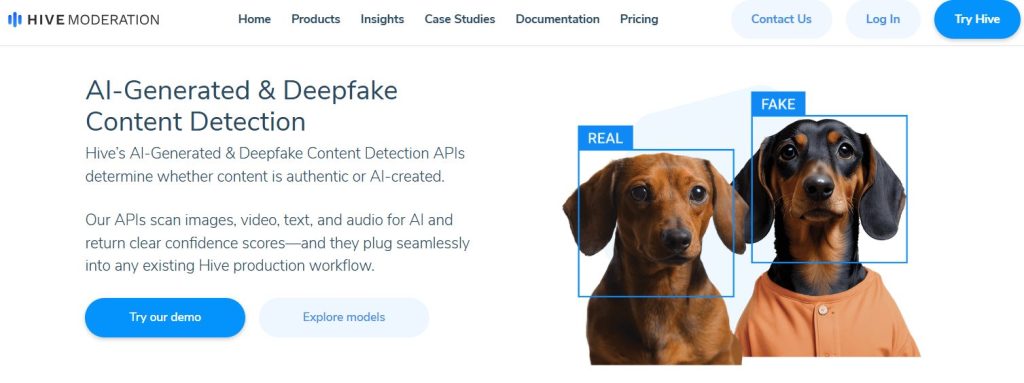
Because modern generative models can produce highly realistic synthetic media, platforms increasingly rely on automated systems like Hive to help verify the authenticity of user-generated content.
How Hive Detects AI-Generated Media
Hive’s detection engine uses deep learning models trained on large datasets containing both authentic and AI-generated media. When a file is analyzed, the system evaluates visual patterns, structural inconsistencies, and generative artifacts that frequently appear in content produced by AI models.
The platform examines signals such as:
- Pixel-level inconsistencies in generated images or videos
- Generative patterns associated with diffusion-based AI models
- Abnormal visual textures or noise patterns
- Motion inconsistencies in synthetic video frames
By analyzing these signals, Hive can estimate whether a piece of content was likely created by generative AI tools.
Platform Features and Capabilities
Hive’s AI detection platform includes several features that make it particularly valuable for content moderation and digital media verification.
Multi-format detection
Hive can analyze images, video, audio, and text within a single platform.
Confidence scoring system
The platform returns probability scores indicating the likelihood that content was AI-generated.
API integration
Developers can integrate Hive’s detection system directly into websites, applications, and moderation pipelines.
Scalable moderation infrastructure
The platform is designed to handle large volumes of media analysis, making it suitable for platforms that process thousands of uploads daily.
Real-World Applications
Hive’s detection technology is widely used by companies and digital platforms that need to manage large amounts of user-generated media.
Common applications include:
- Social media moderation, where platforms must detect synthetic or manipulated media
- Online marketplaces, where fake product images or videos may be generated using AI
- Content authenticity verification, particularly in news and media environments
- AI-generated media filtering, helping prevent the spread of misleading synthetic content
Because of its scalability and automation capabilities, Hive has become an important tool for organizations seeking to maintain trust and authenticity within digital media ecosystems.
AI or Not
AI or Not is a simple and accessible tool designed to help users quickly determine whether digital media may have been generated using artificial intelligence. Unlike complex moderation platforms built for enterprise systems, AI or Not focuses on providing a fast and easy verification process for individuals who want to analyze suspicious media.
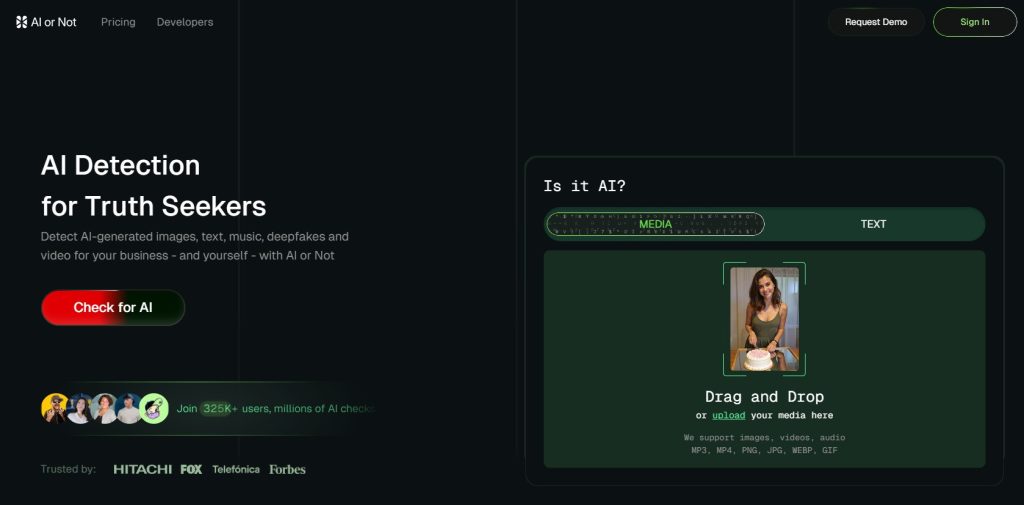
The platform has gained popularity among journalists, educators, and researchers who frequently need to verify whether viral images or videos circulating online were produced by generative AI models.
How AI or Not Analyzes Media
AI or Not evaluates uploaded media by analyzing visual patterns commonly produced by generative AI models. The detection system examines characteristics that often appear in synthetic images or videos created by diffusion models or other generative technologies.
Some of the signals analyzed by the platform include:
- Texture inconsistencies in generated media
- Unusual noise patterns produced by diffusion models
- Repeating visual artifacts within AI-generated imagery
- Structural irregularities in synthetic visuals
By detecting these patterns, the system can estimate whether the uploaded content may have been produced by artificial intelligence.
Interface and User Experience
One of the main advantages of AI or Not is its straightforward and beginner-friendly interface. Users can simply upload an image or media file to the platform, and the system quickly analyzes the content.
The platform then provides an evaluation indicating whether the media is likely to be AI-generated or human-created. Because the process requires minimal technical knowledge, AI or Not is often used as a quick verification tool for suspicious media found online.
Why AI or Not Is Useful for Media Verification
In the age of generative AI, viral images and videos can spread across the internet within minutes. Tools like AI or Not allow users to quickly analyze content before sharing it further.
This capability is particularly valuable for:
- Journalists verifying viral media
- Educators teaching digital literacy
- Content creators analyzing AI-generated trends
- Researchers studying generative AI content
While the platform does not replace advanced detection systems used by large moderation platforms, it provides a convenient method for quickly evaluating whether a piece of media may have been generated by artificial intelligence.
Deepware Scanner
Deepware Scanner is a specialized platform developed to detect deepfake videos and other forms of manipulated media. The tool allows users to upload suspicious video clips and analyze whether the footage contains signs of synthetic manipulation or artificial editing.

As deepfake technology becomes increasingly sophisticated, verifying the authenticity of viral video clips has become more challenging. Deepware addresses this issue by using machine learning models designed to identify patterns that commonly appear in manipulated or AI-generated videos.
The platform is widely used by journalists, cybersecurity researchers, investigators, and media organizations that need reliable tools for verifying whether a video may have been artificially altered.
How Deepware Detects Deepfake Videos
Deepware’s detection system analyzes video content frame by frame to identify inconsistencies that often occur in deepfake media. Because deepfake algorithms typically manipulate facial features or replace faces entirely, the system focuses heavily on facial analysis.
Some of the signals the platform evaluates include:
- Irregular facial movements or unnatural expressions
- Mismatched lighting across facial regions
- Frame-level artifacts produced by deepfake algorithms
- Inconsistent motion patterns within manipulated video segments
By identifying these anomalies, Deepware can estimate whether a video may contain deepfake elements.
Key Features of Deepware Scanner
Deepware Scanner includes several features that make it particularly useful for verifying suspicious media.
Video upload analysis
Users can upload video clips directly to the platform for analysis.
Frame-by-frame scanning
The system analyzes video frames to identify manipulation artifacts.
Deepfake detection models
Machine learning models trained specifically to identify deepfake video patterns.
Media verification support
The tool helps journalists and investigators verify the authenticity of viral content.
Real-World Use Cases
Deepware’s technology is commonly used in scenarios where verifying video authenticity is critical.
Examples include:
- Investigating viral videos that may contain manipulated footage
- Fact-checking media content shared on social networks
- Analyzing potential deepfake scams or impersonation videos
- Supporting journalism and digital investigations
As deepfake technologies continue to improve, platforms like Deepware provide important tools for identifying manipulated content before it spreads widely across the internet.
Hastewire AI Detector
Hastewire provides an accessible AI detection tool designed to help users evaluate whether media content may have been generated or manipulated using artificial intelligence. The platform focuses on identifying visual and audio cues that commonly appear in synthetic media.

As generative AI tools become more widely available, AI-generated images and videos are increasingly shared across social media platforms. Hastewire offers a quick and convenient way for users to verify whether suspicious media may have been produced using artificial intelligence.
The tool is particularly useful for individuals who encounter viral videos or suspicious content online and want a fast way to analyze whether the media might be artificially generated.
How the Hastewire AI Detector Works
The Hastewire detection system evaluates media files by analyzing visual and audio patterns commonly produced by generative AI models. These signals may include artifacts created during AI generation or inconsistencies in motion and visual textures.
The platform examines factors such as:
- Generative visual artifacts in synthetic images or videos
- Inconsistent textures or patterns within media frames
- Motion irregularities that appear in AI-generated videos
- Audio signals that may indicate synthetic speech generation
By evaluating these signals, the system can estimate whether the uploaded media may have been generated by artificial intelligence.
Interface and Ease of Use
One of Hastewire’s strengths is its simple interface. Users can upload media files and quickly receive an analysis indicating whether the content might contain AI-generated elements.
Because the platform does not require advanced technical knowledge, it is particularly useful for everyday users who want to verify suspicious media circulating online.
Why Tools Like Hastewire Are Useful
While advanced moderation platforms are often used by large organizations, accessible tools like Hastewire allow individuals to verify media content themselves.
These tools can help users:
- Evaluate suspicious videos shared on social media
- Identify potential deepfake content
- Verify media before sharing it online
- Improve digital literacy regarding synthetic media
As AI-generated content becomes more widespread, accessible verification tools will play an important role in helping users understand whether the media they encounter online is authentic or artificially created.ncies, Hastewire helps users determine whether a piece of content may have been produced using AI technologies.
Limitations of Detection Tools
While AI detection platforms can provide valuable insights, no system can guarantee perfect accuracy. Generative AI models continue to improve rapidly, and detection technologies must constantly adapt to keep pace with new techniques.
For this reason, experts recommend combining automated detection tools with careful human observation. By downloading videos for closer inspection, analyzing them frame by frame, and using specialized detection platforms, viewers can make more informed judgments about whether a video may have been artificially generated.
The Real-World Risks of AI Video Manipulation
AI-generated videos are not always harmful. Many creators use them for storytelling, marketing, and entertainment. However, synthetic media can also be used for deceptive purposes.
Misinformation and Fake News
AI videos can be used to fabricate events that never occurred, potentially spreading misinformation across social media platforms.
Deepfake Scams
Some scammers use synthetic videos to impersonate public figures or executives in order to manipulate viewers or investors.
Fake Celebrity Endorsements
AI-generated content may also create the illusion that celebrities support certain products or services when they do not.
Understanding these risks highlights the importance of learning how to identify suspicious content online.
The Future of AI Video Detection
As AI video generation becomes more sophisticated, detection methods will also continue evolving.
Researchers are exploring new solutions such as:
- Digital watermarking systems embedded within AI-generated content
- Blockchain verification for authentic video recordings
- Advanced AI detectors trained to recognize generative patterns
These technologies aim to provide stronger verification systems that help viewers confirm whether a video is authentic.
At the same time, media literacy will remain an essential skill for navigating the digital landscape.
Conclusion: Becoming a Smarter Viewer in the Age of AI Media
Artificial intelligence is reshaping the way videos are produced and shared online. While these tools offer powerful creative possibilities, they also make it more challenging to determine what content is genuine.
Learning how to spot AI-generated videos is an important step toward becoming a more informed digital citizen. By paying attention to facial expressions, hand movements, lighting behavior, background consistency, and audio synchronization, viewers can identify many of the clues that synthetic videos often reveal.
As AI technology continues to evolve, awareness and critical thinking will play a vital role in maintaining trust within online media ecosystems.
The ability to question and analyze digital content is no longer just a skill for journalists or researchers—it is becoming essential for anyone navigating the modern internet.
