
In today’s algorithm-driven digital ecosystem, visibility is no longer controlled by creativity alone—it is governed by data. Social media has evolved into a performance battlefield where brands compete not just for attention, but for measurable impact. The organizations that win are not the loudest; they are the most informed.
For a digital publication like GetInDevice News, where authority, discoverability, and sustained audience growth are core objectives, social media analytics tools are not optional add-ons. They are the strategic infrastructure behind editorial refinement, distribution optimization, and long-term digital dominance.
Why Social Media Analytics Is the Backbone of Modern Marketing
Every post, reel, short, carousel, and thread generates behavioral signals. Within those signals lies a blueprint for sustainable growth.
Social media analytics is not about counting likes. It is about decoding digital intent:
- Why did one post trigger saves and shares while another was ignored?
- Why does engagement spike on certain formats even with lower reach?
- Why do competitors dominate specific conversations during industry shifts?
- Which content patterns drive actual conversions?
Modern marketing has moved beyond “post and pray.” Today, strategy is built on:
- Engagement velocity
- Conversion attribution
- Audience sentiment analysis
- Competitive benchmarking
- Share of Voice (SOV)
- Cross-platform performance tracking
Brands that leverage professional social media reporting software stop guessing and start engineering outcomes.
The Evolution from Vanity Metrics to Revenue Metrics
In the early days of social media, success was measured by follower counts and visible likes. While those numbers looked impressive, they rarely reflected real business impact. Visibility without conversion is not growth — it is noise.
Today, professional marketing focuses on performance-driven metrics that connect attention to outcomes:
Engagement Rate (Relative to Reach)
Measures how strongly content resonates with the actual audience exposed to it — not just total followers.
Share of Voice (SOV)
Evaluates how much of the industry-wide conversation your brand owns compared to competitors.
Conversion Attribution
Tracks the direct path from social interaction to revenue, lead generation, or subscription.
Sentiment Intelligence
Analyzes emotional tone to assess brand perception and community trust.
The move from vanity metrics to revenue metrics represents the shift from surface-level visibility to measurable digital strategy.
Navigating the Complexity of Modern Social Media Reporting
Reporting has evolved from spreadsheets and screenshots to real-time cross-platform analytics dashboards. However, automation does not remove complexity—it shifts it.
The modern challenge is not data collection. It is data interpretation.
Different tools specialize in different layers of analysis:
- Integrated cross-channel reporting
- Competitive social media analysis
- Social listening and brand monitoring
- Influencer performance validation
- Executive-level ROI tracking
- Multi-channel attribution modeling
Selecting the right tool requires clarity about your strategic objective.
Hootsuite: The Enterprise Benchmark for Integrated Social Media Analytics
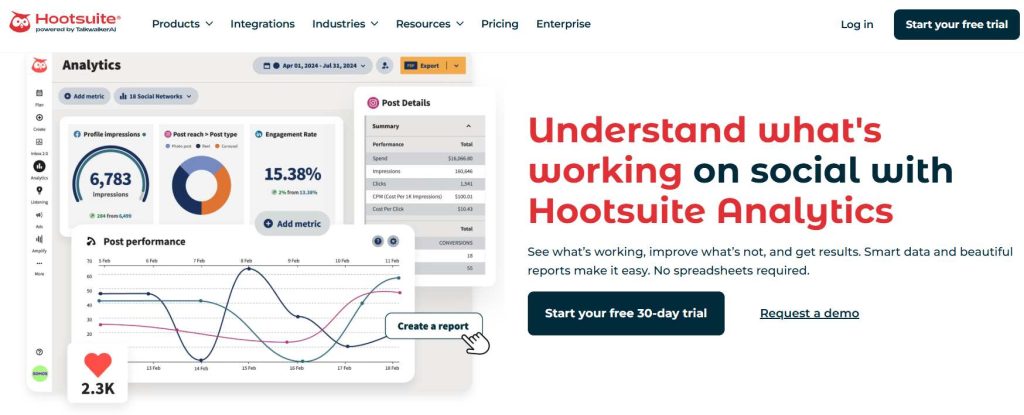
Hootsuite is widely recognized as one of the most mature and enterprise-ready social media analytics platforms available. What differentiates it is not just breadth of platform coverage, but the depth of performance intelligence layered into a single dashboard.
It centralizes analytics across major networks including:
- X
- TikTok
- YouTube
This unified system eliminates fragmented reporting and prevents data silos — a common issue in large organizations where teams operate platform-by-platform. By consolidating performance data, Hootsuite enables strategic alignment between content, paid media, customer support, and executive leadership.
For brands managing multiple regions or departments, this cross-platform visibility becomes a structural advantage.
Advanced, Executive-Level Custom Reporting
Hootsuite’s reporting engine is built for decision-makers, not just social media managers.
Users can create fully customizable dashboards using drag-and-drop widgets that display:
- Engagement rate and audience growth trends
- Campaign-level ROI tracking
- Post-level performance analysis
- Paid versus organic breakdowns
- Response time and team productivity metrics
- Competitor benchmarking comparisons
Reports can be exported in multiple formats, automated on scheduled intervals, and tailored to specific stakeholder needs. This makes it suitable for board-level presentations and client reporting environments.
One of its strongest USPs is its ability to translate complex performance data into structured narratives — turning analytics into strategic storytelling.
ROI Attribution and Social Commerce Integration
Hootsuite moves beyond surface engagement by integrating with analytics and advertising ecosystems to track measurable business outcomes.
Through integrations and tracking capabilities, brands can:
- Connect social campaigns to website conversions
- Monitor click-through performance from posts
- Track lead generation from social ads
- Measure direct revenue impact
- Attribute conversions to specific campaigns or content formats
For businesses focused on performance marketing, this bridges the gap between content visibility and financial return.
Team Productivity and Customer Interaction Metrics
Unlike many analytics-only platforms, Hootsuite also evaluates operational efficiency.
It provides:
- Average response time tracking
- Resolution rate analytics
- Message volume monitoring
- Individual team member performance data
For brands prioritizing community management and customer experience, these metrics are critical to maintaining brand trust and response consistency.
Competitive Benchmarking and Industry Comparison
Hootsuite includes benchmarking tools that allow brands to compare performance against industry averages and selected competitors.
This contextualizes performance metrics. A 3% engagement rate means little in isolation — but when benchmarked against industry norms, it becomes actionable insight.
Pricing Structure and Access Model
Hootsuite operates primarily as a paid SaaS platform. It offers tiered subscription plans designed for:
- Small businesses
- Growing marketing teams
- Agencies
- Enterprise organizations
While limited trial access is typically available, advanced analytics features, team collaboration tools, and benchmarking capabilities are part of its paid ecosystem. This positions it as a premium solution rather than a lightweight free tool.
Core Strengths That Differentiate Hootsuite
- Enterprise-grade cross-platform analytics
- Customizable executive reporting dashboards
- Integrated ROI and conversion tracking
- Team productivity measurement
- Competitive benchmarking
- Social commerce performance integration
For organizations seeking a centralized, scalable, and performance-driven social media analytics system, Hootsuite functions as a strategic command center rather than just a reporting tool.
In the broader landscape of social media analytics tools, it remains the benchmark for integrated performance intelligence and operational visibility.
Socialinsider: Precision Benchmarking and Competitive Intelligence
Socialinsider is purpose-built for brands that understand performance does not exist in isolation. Numbers only become meaningful when they are contextualized against competitors and industry standards.

The platform allows users to track public competitor profiles across major social networks and analyze:
- Posting frequency and content cadence
- Engagement distribution across formats
- Follower growth trends
- Top-performing posts by engagement rate
- Hashtag usage patterns
- Content type breakdown (video, carousel, static, short-form)
This level of visibility enables brands to reverse-engineer what is working within their niche. Instead of guessing content direction, marketing teams can identify structural patterns behind competitor success and adapt strategically.
Industry Benchmarking and Contextual Performance Scoring
One of Socialinsider’s strongest differentiators is its industry benchmarking framework.
Rather than simply displaying raw engagement metrics, the platform compares performance against aggregated industry averages. This allows brands to determine whether their engagement rate, reach growth, or posting cadence is:
- Above industry standard
- Within expected range
- Underperforming relative to peers
This contextual scoring prevents false confidence. A 2% engagement rate may seem strong internally, but if industry leaders average 4%, it signals optimization opportunities.
For agencies and in-house teams alike, industry benchmarking provides objective validation of strategic decisions.
Paid vs Organic Analysis and Campaign Tracking
Socialinsider also distinguishes between organic performance and paid amplification. This separation helps brands understand whether engagement is driven by authentic audience interest or advertising budget.
Key campaign-level insights include:
- Organic engagement trends over time
- Ad-driven spikes and performance surges
- Content efficiency relative to spend
- Platform-specific performance comparisons
This clarity is essential for performance marketers optimizing ROI and media allocation.
Historical Data and Predictive Performance Insights
Beyond snapshot analytics, Socialinsider analyzes historical data patterns to identify recurring performance trends.
By evaluating months of engagement data, the platform highlights:
- Optimal publishing days and time windows
- Format trends gaining traction
- Seasonal engagement patterns
- Engagement decay rates over time
This shifts strategy from reactive reporting to predictive planning.
Rather than asking, “What happened last month?” teams begin asking, “What format and timing will maximize next month’s performance?”
For editorial platforms, this predictive intelligence allows structured content scheduling that aligns with proven audience behavior.
Reporting, Dashboards, and Data Visualization
Socialinsider offers clean, visual dashboards designed for strategic interpretation rather than raw data overload.
Reports can be exported and customized for:
- Executive summaries
- Competitive landscape analysis
- Monthly performance reviews
- Client presentations
The visualization layer simplifies complex benchmarking data, making it accessible to both marketing teams and leadership stakeholders.
Pricing Model and Accessibility
Socialinsider operates as a subscription-based SaaS platform. It offers tiered pricing structures tailored to:
- Small marketing teams
- Agencies managing multiple clients
- Enterprise-level brands requiring advanced benchmarking
While trial access is typically available, its advanced benchmarking features, historical analytics depth, and multi-profile tracking capabilities are part of its paid ecosystem.
This positions it as a premium competitive intelligence solution rather than a lightweight analytics add-on.
Core Differentiators of Socialinsider
- Advanced competitive benchmarking
- Industry-average performance comparison
- Paid vs organic segmentation
- Historical pattern analysis for predictive insights
- Clean visual dashboards for executive reporting
In the broader landscape of social media analytics tools, Socialinsider stands out as a strategic benchmarking engine. It does not merely report performance; it contextualizes it, compares it, and translates it into competitive advantage.
For brands seeking measurable authority rather than isolated metrics, Socialinsider provides the structural clarity required to compete — and lead — within their industry.
Rival IQ: Real-Time Competitive Monitoring and Social Audits
Rival IQ is engineered for marketers who need to react as fast as the market moves. Its standout capability lies in competitive monitoring powered by automated alerts.
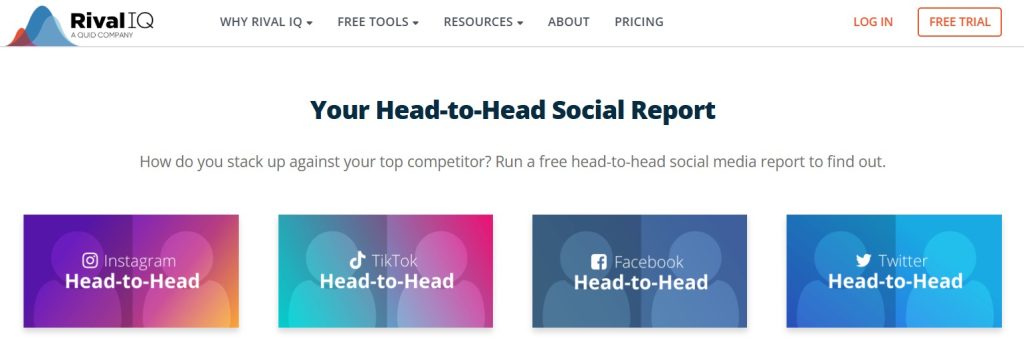
The platform tracks competitor accounts continuously and flags “breakout” posts — content that significantly outperforms a competitor’s normal engagement baseline. This allows brands to:
- Identify emerging trends early
- Analyze high-performing formats in real time
- Evaluate hashtag and caption strategies
- Observe shifts in audience behavior
Instead of discovering trends weeks later in a monthly report, teams can respond while momentum is still building. In fast-moving niches like tech news, digital marketing, or creator ecosystems, this level of agility creates a measurable strategic edge.
Structural Social Media Audits
Beyond real-time alerts, Rival IQ offers deep structural audits designed to diagnose long-term performance health.
It evaluates:
- Content Gaps: Identifies underutilized formats or themes that competitors are successfully leveraging.
- Engagement Volatility: Tracks abnormal spikes or drops to understand whether growth is sustainable or inconsistent.
- Follower Growth Anomalies: Detects irregular patterns that may indicate viral events, algorithm shifts, or inorganic activity.
- Profile Optimization Weaknesses: Reviews posting cadence, bio structure, content mix, and overall profile consistency.
This diagnostic approach transforms analytics from reactive reporting into structural refinement. Brands can correct systemic inefficiencies rather than merely adjusting surface-level tactics.
Advanced Competitive Landscape Analysis
Rival IQ also enables multi-competitor landscape tracking. Users can build custom competitor sets and compare performance metrics side-by-side, including:
- Engagement rate distribution
- Audience growth trajectories
- Content type breakdown
- Hashtag performance trends
- Posting frequency analysis
This comparative framework clarifies market positioning. It reveals whether your brand is leading, matching, or trailing competitors in key performance areas.
Short-Form Video Analytics for High-Growth Platforms
With the rapid dominance of TikTok and Instagram Reels, Rival IQ has invested heavily in short-form video analytics.
Its platform analyzes:
- Video engagement rate trends
- Caption structure and length effectiveness
- Audio and sound usage impact
- Hashtag density and discovery patterns
- Posting timing correlations
Short-form video often behaves differently from static content. Rival IQ provides granular insight into the mechanics behind virality, helping brands refine hooks, format structure, and distribution timing.
For editorial brands translating long-form articles into short-form content, this data becomes essential for maximizing cross-platform reach.
Reporting and Data Visualization
Rival IQ’s reporting system is structured for clarity and strategic evaluation. Performance dashboards provide both macro-level summaries and micro-level content insights.
Reports can be customized for:
- Monthly competitive reviews
- Executive performance briefings
- Campaign impact analysis
- Social health audits
The visualization style emphasizes comparability, making it easy to identify performance gaps at a glance.
Pricing Model and Access
Rival IQ operates on a subscription-based SaaS model. It is primarily designed for:
- Marketing teams
- Agencies
- Competitive research departments
- Enterprise brands requiring advanced benchmarking
While trial access is generally available, its most advanced features — including breakout alerts and in-depth competitor landscapes — are part of paid plans.
Core Differentiators of Rival IQ
- Real-time breakout post alerts
- Deep structural social audits
- Multi-competitor landscape comparison
- Short-form video performance intelligence
- Engagement volatility monitoring
In the competitive analytics ecosystem, Rival IQ positions itself as a proactive intelligence platform rather than a passive reporting tool. It does not simply show what happened — it highlights where the market is shifting and where your brand must adapt.
For brands focused on strategic agility and sustained authority, Rival IQ provides the diagnostic clarity required to compete at a high level., Rival IQ analyzes caption performance, audio trends, and structural elements influencing virality.
Statusbrew: Unified Engagement and Sentiment Intelligence
Statusbrew positions itself at the intersection of analytics and customer experience. While many platforms focus solely on performance metrics, Statusbrew prioritizes brand perception intelligence.
Its AI-driven sentiment engine automatically categorizes conversations into:
- Positive
- Neutral
- Negative
This real-time classification enables brands to detect emotional shifts within their community before they escalate into reputational risks. For publishers, SaaS brands, or consumer-facing businesses, understanding how audiences feel about content is as important as knowing how many people interacted with it.
Sentiment analytics transforms raw mentions into actionable reputation management insights.
Unified Inbox and Community Health Metrics
One of Statusbrew’s strongest operational advantages is its Unified Inbox system. It centralizes comments, mentions, direct messages, and ad interactions across multiple social platforms into a single interface.
Beyond consolidation, the platform tracks critical community management KPIs such as:
- Response rate
- Average response and resolution time
- Message volume trends
- Escalation frequency
- Individual team productivity
This turns social engagement into measurable operational performance.
For brands focused on retention, loyalty, and customer satisfaction, this level of reporting ensures that community management becomes structured rather than reactive.
Workflow Automation and Team Collaboration
Statusbrew also includes workflow automation tools that allow:
- Message tagging and categorization
- Internal note sharing
- Role-based access control
- Approval workflows for publishing
These features make it particularly attractive to agencies and multi-member teams handling high volumes of social interactions.
Pricing and Positioning
Statusbrew operates on a subscription-based model, offering tiered plans suitable for:
- Growing brands
- Agencies
- Enterprise teams requiring multi-user collaboration
Advanced reporting, sentiment analysis, and workflow automation are part of its paid ecosystem, positioning it as a professional community intelligence platform rather than a basic analytics tool.
Whatagraph: Cross-Channel Visual Reporting and Marketing Intelligence
Whatagraph is built on a clear principle: data must be visually digestible to drive strategic decisions.
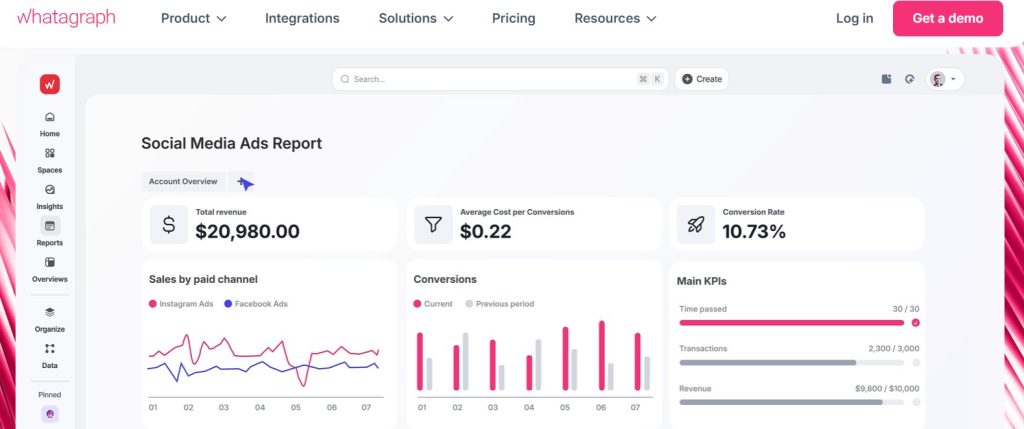
Instead of overwhelming stakeholders with spreadsheets and raw exports, it transforms complex performance data into clean, structured dashboards designed for:
- Executive briefings
- Client presentations
- Agency reporting
- Internal performance reviews
Its visual dashboards highlight growth patterns, performance gaps, anomalies, and ROI impact in a single, structured view. This makes it especially valuable for agencies and marketing leaders who need clarity, not clutter.
Multi-Source Integration and Unified Marketing View
Whatagraph’s core strength lies in its integration ecosystem. It connects with a wide range of platforms across the marketing stack, including:
- Social media platforms
- Website analytics tools
- CRM systems
- Paid advertising dashboards
- Email marketing software
By consolidating data into one interface, it enables full-funnel visibility — from social engagement to website behavior to final conversion. This unified perspective helps brands understand not just what performed well, but what actually generated revenue.
Automation and Operational Efficiency
Manual reporting is one of the most time-consuming tasks in digital marketing. Whatagraph reduces that burden through:
- Automated report scheduling
- Real-time data syncing
- Shareable live dashboards
- White-label reporting options
For agencies managing multiple accounts or marketing teams handling cross-channel campaigns, this automation significantly improves efficiency and transparency.
Positioning and Pricing Model
Whatagraph operates as a premium SaaS solution with tiered plans tailored for agencies and performance-driven marketing teams. While it is not positioned as a free analytics tool, its value lies in streamlining complex reporting workflows and delivering cross-channel clarity at scale.
Core Strengths
- Cross-channel performance aggregation
- Executive-ready visual dashboards
- Automated reporting
- Full-funnel attribution visibility
- Multi-client reporting capabilities
Within a comprehensive social media analytics strategy, Whatagraph serves as the visualization engine that converts scattered performance data into a clear, strategic growth narrative.
Social Status: Influencer ROI and Organic Performance Clarity
Social Status focuses on one of the most complex areas in modern social media marketing: influencer performance transparency.
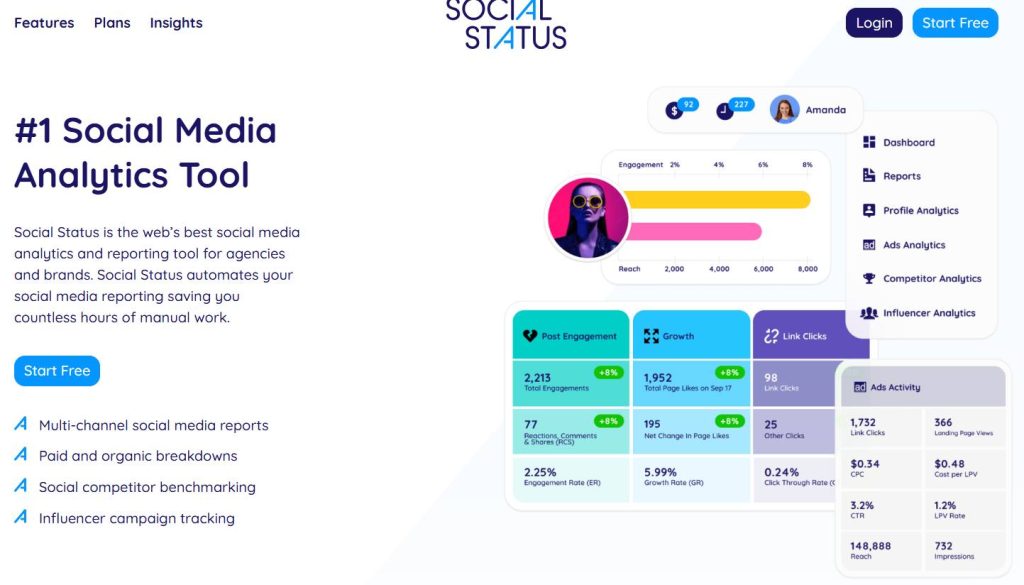
Native platform analytics often fragment creator data across profiles, posts, and ad dashboards. Social Status consolidates influencer-generated content into unified campaign reports, measuring:
- Total reach and impressions
- Engagement rate and interaction quality
- Audience growth during campaign windows
- Campaign-level performance metrics
- Conversion indicators (when tracking integrations are enabled)
This structured aggregation allows brands to move beyond vanity impressions and evaluate whether influencer collaborations delivered measurable business impact.
For performance-driven teams, this clarity turns influencer marketing from experimental spending into accountable investment.
Earned vs Paid Reach Segmentation
A key differentiator of Social Status is its ability to clearly separate organic performance from paid amplification.
Rather than blending metrics, the platform distinguishes:
- Earned (organic) reach
- Paid reach from boosted posts or ads
- Engagement driven by natural audience interest
- Performance influenced by media spend
This segmentation helps brands determine:
- Whether content is inherently shareable
- How much traction was budget-dependent
- Which campaigns generated authentic audience resonance
For marketers optimizing ROI, understanding the organic strength of a campaign is critical for refining creative direction and reducing unnecessary ad expenditure.
Campaign-Level and Ad Account Analytics
Beyond influencer validation, Social Status also supports detailed profile and ad account analytics. It provides breakdowns of:
- Content type performance
- Video vs static engagement comparison
- Posting frequency impact
- Platform-specific engagement trends
This makes it useful not only for influencer campaigns but also for broader social media performance tracking.
Lightweight, Fast Reporting for Agile Teams
Social Status is designed for speed and usability. Its reporting interface allows teams to quickly generate campaign-specific insights without navigating complex enterprise systems.
This makes it particularly valuable for:
- Short-term product launches
- Time-sensitive promotional campaigns
- Influencer activations
- Agency client reporting
When quick insight is required, the platform delivers clarity without operational friction.
Pricing and Positioning
Social Status operates on a subscription-based SaaS model with tiered pricing plans suitable for:
- Marketing teams
- Agencies managing multiple accounts
- Brands running regular influencer campaigns
It is positioned as a performance-focused analytics solution rather than a general social management tool.
Core Strengths
- Influencer campaign consolidation and ROI validation
- Clear earned vs paid performance segmentation
- Profile and ad account analytics
- Fast, campaign-specific reporting
- Agency-friendly structure
Within a comprehensive social media analytics ecosystem, Social Status fills a critical gap: it brings financial accountability and structural clarity to influencer and paid social performance.
Mentionlytics: AI-Powered Brand Monitoring Across the Web
Mentionlytics expands analytics beyond traditional social networks, delivering full-spectrum brand monitoring across the open web.
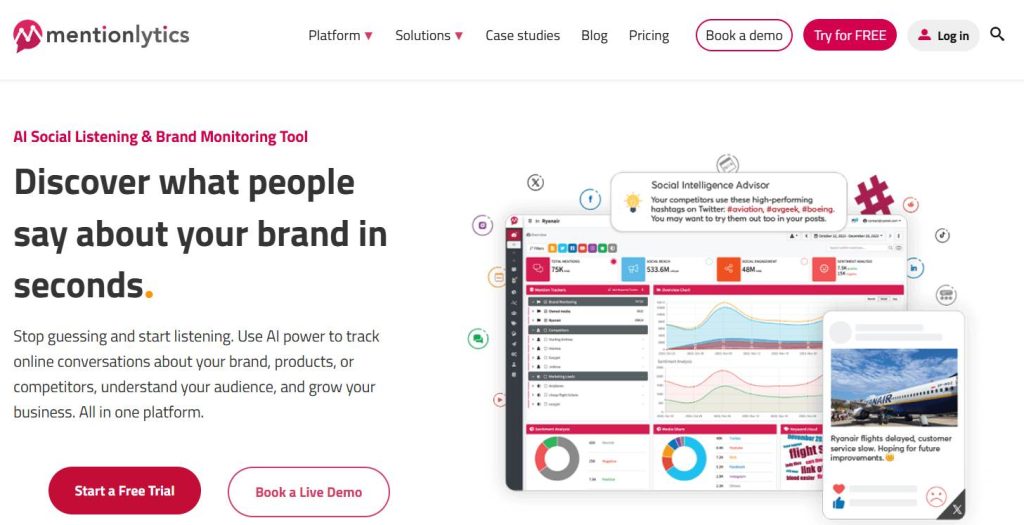
It tracks brand mentions across:
- Blogs
- Forums
- News sites
- Online publications
- Social media platforms
This broader intelligence layer ensures brands remain aware of conversations happening outside their owned channels.
For digital publishers and media platforms, this is particularly powerful. It helps identify:
- Unlinked brand mentions
- Backlink opportunities
- Media citations
- Community-driven discussions
- Emerging narratives within niche forums
Rather than focusing only on engagement metrics, Mentionlytics monitors reputation footprint at scale.
The Social Intelligent Advisor
One of the platform’s most distinctive features is its AI-powered “Social Intelligent Advisor.”
Instead of passively displaying mention counts, the system analyzes sentiment patterns and engagement shifts to generate strategic recommendations. For example:
- Detecting rising negative sentiment around a product issue
- Identifying spikes in conversation volume
- Highlighting emerging discussion trends
- Suggesting proactive response strategies
This shifts analytics from descriptive reporting (“what happened”) to prescriptive insight (“what to do next”).
For brands operating in competitive or reputation-sensitive industries, this proactive intelligence becomes a strategic safeguard.
Sentiment Analysis and Reputation Signals
Mentionlytics uses automated sentiment classification to categorize mentions as positive, neutral, or negative.
By tracking sentiment distribution over time, brands can:
- Detect early signs of PR risk
- Monitor perception shifts after campaigns
- Evaluate audience reaction to announcements
- Measure reputation impact during crises
This emotional dimension adds context to quantitative metrics like reach and volume.
Influencer and Advocate Identification
The platform also helps brands identify individuals who frequently mention or engage with their content.
By analyzing engagement patterns and recurring mentions, it surfaces:
- Organic brand advocates
- Potential influencer partners
- Industry commentators
- Community amplifiers
This data-driven discovery is more strategic than manual hashtag searches, allowing brands to formalize partnerships with individuals who already demonstrate authentic alignment.
Pricing Structure and Ideal Use Cases
Mentionlytics operates on a subscription-based SaaS model with tiered plans designed for:
- Small businesses
- Marketing teams
- PR departments
- Agencies requiring advanced monitoring
Its positioning sits between traditional social listening tools and advanced reputation intelligence platforms.
Core Strengths
- Web-wide brand monitoring beyond social platforms
- AI-driven strategic recommendations
- Sentiment tracking and reputation analysis
- Influencer and advocate identification
- Competitive mention comparison
Within a complete social media analytics ecosystem, Mentionlytics functions as the reputation intelligence layer — ensuring that brands are not only measuring performance, but actively managing perception across the digital landscape.I-driven recommendations positions it as a hybrid between social listening software and reputation intelligence platform.
Choosing the Right Social Media Analytics Tool Based on Strategic Goals
Not every brand requires the same analytics stack. The right platform depends on your primary growth objective and operational structure.
- Enterprise & Multi-Team Operations: Hootsuite — Ideal for centralized reporting, cross-department visibility, and executive dashboards.
- Competitive Benchmarking & Market Positioning: Socialinsider or Rival IQ — Best for industry comparison, competitor intelligence, and performance gap analysis.
- Social Listening & Reputation Management: Statusbrew or Mentionlytics — Designed for sentiment tracking, brand monitoring, and community health metrics.
- Influencer ROI & Paid vs Organic Clarity: Social Status — Focused on campaign validation and performance segmentation.
- Automated Cross-Channel Reporting & Attribution: Whatagraph — Built for unified dashboards and full-funnel visibility.
The decision should align with your core priority: visibility, benchmarking, reputation management, attribution accuracy, or reporting automation. Clarity of objective precedes tool selection.
Essential Metrics for a Professional Social Media Strategy
A mature analytics framework focuses on impact-driven indicators rather than surface engagement.
Engagement Rate (Relative to Reach)
Measures how effectively content resonates with those actually exposed to it, providing a more accurate performance indicator than follower-based calculations.
Share of Voice (SOV)
Evaluates brand authority by measuring your portion of total industry conversation compared to competitors.
Reach vs. Impressions
Distinguishes between unique exposure (reach) and repeat visibility (impressions), helping assess content stickiness and audience retention.
Sentiment Distribution
Tracks emotional tone shifts across audience conversations, serving as an early indicator of reputation risk or positive momentum.
Conversion Attribution
Connects social interactions directly to business outcomes such as leads, subscriptions, or revenue, completing the performance loop.
These metrics form the structural backbone of data-driven decision-making.
Building a Sustainable Analytics Culture
Analytics should not be confined to monthly reporting cycles. High-growth organizations integrate data review into weekly operational rhythms.
Professional teams implement:
- Structured performance review sessions
- Reverse-engineering of high-performing content
- Internal benchmarking frameworks
- Cross-functional collaboration between analytics and editorial teams
When insights directly inform editorial planning, publishing cadence, and content format strategy, growth becomes repeatable rather than accidental.
Data must move from dashboard to decision.
Future-Proofing Social Media Strategy
The digital ecosystem is dynamic. Algorithms evolve, new platforms emerge, and audience behaviors shift continuously.
Brands that sustain authority focus on foundational principles:
- Audience psychology and behavior mapping
- Competitive positioning within industry conversations
- Revenue attribution clarity
- Continuous sentiment monitoring
- Cross-platform data integration
The next frontier lies in AI-driven predictive modeling — systems capable of forecasting performance trends before content is published. Organizations that embrace predictive intelligence will operate with strategic foresight rather than reactive adjustment.
Final Strategic Perspective
Social media analytics is no longer a secondary marketing function. It is the strategic infrastructure of modern digital growth.
When executed with discipline and supported by the right tools, analytics transforms:
- Content into measurable capital
- Engagement into brand authority
- Data into sustainable competitive advantage
In an increasingly saturated attention economy, informed brands do not chase trends — they anticipate them and shape the conversation.
For platforms such as GetInDevice News, mastering social media analytics tools is not merely about tracking performance. It is about engineering long-term digital authority, structured growth, and market leadership.
