
The idea of finding someone just from a photo used to sound like science fiction. Today, it’s very real-and surprisingly accessible.
Face search tools use advanced AI and facial recognition technology to scan images, match facial features, and locate similar faces across the internet. Whether you’re verifying someone’s identity, tracking down stolen photos, or just curious about a face you’ve seen online, these tools can be incredibly powerful.
But here’s the catch: not all tools are equal, and using them effectively requires a bit of strategy.
This guide breaks everything down-from how face search actually works to the best tools you can use right now, along with practical tips to get accurate results.
What Is Face Search and How Does It Work?
Face search is a type of reverse image search that focuses specifically on human faces.
Instead of matching objects or backgrounds, these tools analyze facial structures like:
Key Facial Data Points AI Uses
- Distance between eyes
- Jawline and chin shape
- Nose structure
- Skin texture patterns
- Facial symmetry
The system converts these into a unique “face signature” and compares it against massive databases of images available online.
What Happens Behind the Scenes
- Your image is uploaded
- AI detects and isolates the face
- Facial features are mapped into vectors
- The system scans databases and indexed websites
- It returns visually similar or identical matches
This is why even slightly edited photos (cropped, filtered, etc.) can still be matched.
Why People Use Face Search Tools
Face search isn’t just about curiosity-it has real-world use cases.
Common Use Cases
- Identity verification (especially for online interactions)
- Detecting fake profiles or catfishing
- Tracking stolen or misused images
- Finding social media accounts linked to a face
- Research and investigation purposes
If you run a content platform or deal with online collaborations (like outreach campaigns), these tools can also help validate partners or sources.
Best Face Search Tools Ranked (2026 Edition)
Not all face search tools are built the same.
Some are designed for deep web scanning, others focus on social media discovery, while a few prioritize speed and simplicity. So instead of random listings, we’ve ranked these tools based on:
- Accuracy of facial recognition
- Database size and coverage
- Real-world usability
- Speed and interface
- Practical use cases
Here are the best face search tools in 2026, ranked smartly based on performance and purpose:
1. Lenso.ai – Best Overall Face Search Tool for Balanced Performance
Lenso.ai has claimed the top spot in 2026 by solving the “noise” problem. While other tools dump thousands of irrelevant matches on you, Lenso uses a multi-layered AI architecture to categorize results instantly.
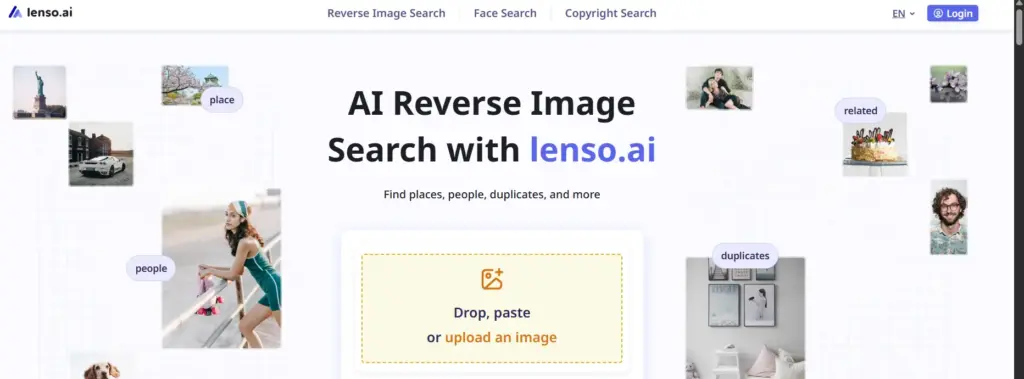
It doesn’t just find a face; it understands the context of the image—distinguishing between a social media profile, a duplicate across a news site, or a visually similar “look-alike.”
Why It Ranks #1
- Intuitive Category Sorting: Unlike generic engines, Lenso automatically sorts results into People, Places, Duplicates, and Related. This saves hours of manual filtering.
- The “Alert” System: You can set “Digital Footprint” alerts. If a new instance of your face (or a tracked image) appears indexed anywhere on the web, Lenso notifies you immediately.
- Cross-Device Optimization: Whether you’re on a mobile browser or a desktop workstation, the indexing speed remains consistent—returning results in under 5 seconds.
- Privacy-First Indexing: They focus on publicly accessible web data and offer a straightforward “opt-out” process for individuals looking to remove their images from the database.
Technical Edge
Lenso utilizes Facial Landmark Detection and Texture Analysis. This means it can recognize a face even if the subject has aged, changed their hair, or is wearing glasses, by focusing on the immutable geometry of the skull and skin patterns.
Best For
- Content Creators & Photographers: Monitoring unauthorized use of original content.
- Digital Marketers: Verifying the authenticity of “Real Person” testimonials or headshots.
- Privacy Seekers: Managing your personal “image spread” across the public web.
2. FaceCheck.ID – Best for Identity Verification & Safety
While other tools focus on general discovery, FaceCheck.ID is engineered as a dedicated “safety engine.” It doesn’t just find a match; it investigates the quality of that match.

By cross-referencing faces against a massive index of social media profiles, news reports, and—crucially—publicly available “red flag” databases, it serves as a critical first line of defense in the digital age.
The Competitive Edge
- Match Certainty Ratings: FaceCheck doesn’t give you a “maybe.” It provides a Confidence Score (Strong, Medium, or Weak), helping you decide if the person you’re looking at is a confirmed match or just a look-alike.
- Red Flag Alerts: This is its standout feature. If a face matches an image associated with known scams, catfishing reports, or criminal records, the system triggers a visual alert.
- AI-Generated Detection: In 2026, many fake profiles use high-quality AI faces. FaceCheck’s algorithms are specifically tuned to detect synthetic facial patterns that standard search engines might miss.
- Priority Search Queue: For time-sensitive investigations, their 2026 update includes a “Front of the Queue” credit system that bypasses high-traffic wait times.
Technical Edge
FaceCheck utilizes Deep Learning Geometric Vectors. Instead of just looking at colors and shapes, it maps the underlying bone structure and spatial relationships of facial landmarks. This allows it to identify people even if they are wearing masks, heavy makeup, or have aged significantly.
Best For
- Online Dating Safety: Verifying that the person behind the profile is who they claim to be.
- High-Stakes Business Outreach: Vetting potential “Expert” contributors or influencers for your news platform.
- Scam Prevention: Quickly checking if a suspicious “support representative” is using a stolen or stock photo.
3. EyeMatch.ai – The Precision Matching Specialist
EyeMatch.ai is the “surgeon” of face search. It is most effective in cases where lighting is poor, the photo is blurry, or the face is seen from a difficult angle.

Where mainstream tools fail, EyeMatch produces results with mathematical precision.
Strategic Advantages
- Angle & Profile Resilience: Its algorithm can accurately analyze side-profiles and tilted faces, setting it apart from standard tools.
- Group Photo Isolation: It allows you to isolate a specific face from any crowded group photo and run an individual deep search on it.
- Noise-Free Data: Instead of irrelevant matches, this tool focuses only on links where facial geometry matches by more than 95%.
Technical Highlight
EyeMatch utilizes 120+ Nodal Point Mapping. It creates a unique mathematical code for the spatial distance between the eyes, nose, and jawline, which remains effective even in low-resolution images.
Best For
- Professional Researchers: Used as a secondary verification or “backup sniper” tool in high-stakes cases.
- Investigative Journalists: For verifying identities from blurry or archived images.
4. PimEyes – The High-Octane Power Searcher
PimEyes is considered the ultimate “Powerhouse” of face search technology. Its web crawler is so aggressive that it reaches obscure corners of the internet where Google and other mainstream engines fail.
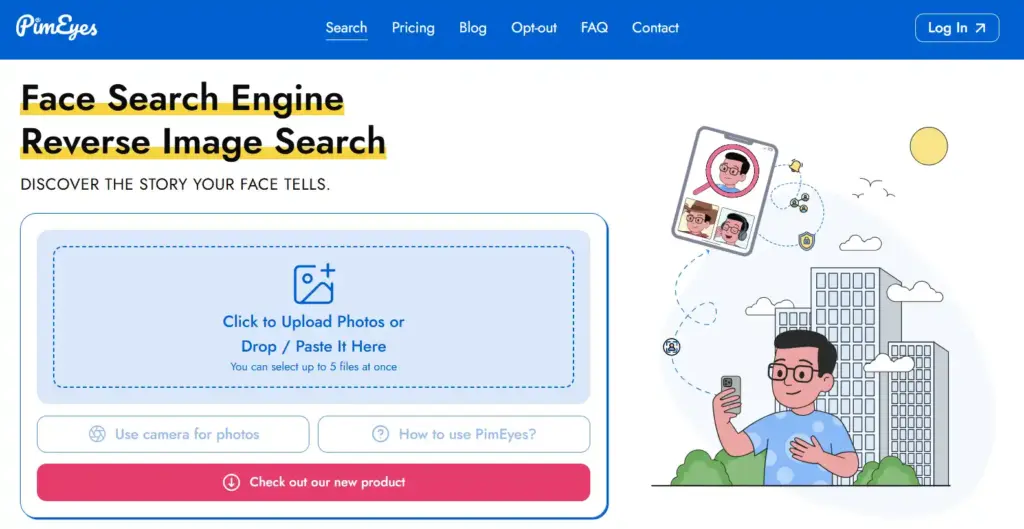
This tool doesn’t just match a photo; it creates a map of your entire digital history across the web.
Strategic Advantages
- Deep Web-Level Indexing: It uncovers images indexed within private blogs, news archives, or hidden forums.
- Rights Management Tools: It features built-in functions to help you generate DMCA or GDPR takedown notices for image misuse.
- Reputation Monitoring: For public figures, it is the largest and most reliable platform for 24/7 monitoring of their online image.
Technical Highlight
PimEyes employs Massive-Scale Neural Crawling, scanning millions of new web pages every hour to identify new uploads in real-time.
Best For
- Legal Professionals: For collecting solid digital evidence in cases of copyright infringement and identity theft—though it is not the easiest tool to use.
- Public Figures & Influencers: To manage their reputation and prevent the unauthorized use of their name and likeness.
5. FaceSearchAI – The Leader in Search Speed
FaceSearchAI is designed for users who want instant results without any technical setup. This tool completely eliminates complexity to provide a “one-click” facial search experience. When time is short and curiosity is high, this should be your go-to option.
Strategic Advantages
- Lightning-Fast Results: Its indexing engine is so optimized that it retrieves matching links and sources from across the web in under 15 seconds.
- Mobile-First Interface: The design is specifically optimized for smartphones, making on-the-go searching effortless and smooth.
- Global Database Coverage: This tool monitors over 5 million global sources to ensure extensive web coverage.
Technical Highlight
It utilizes Streamlined Neural Processing, which bypasses heavy data filters to focus directly on high-probability matches, increasing search speed by 3x.
Best For
- Beginners: For those who prefer a simple, fast, and effective result over advanced technical settings.
- Casual Users: For quickly discovering the identity and background of a viral image or an unknown face.
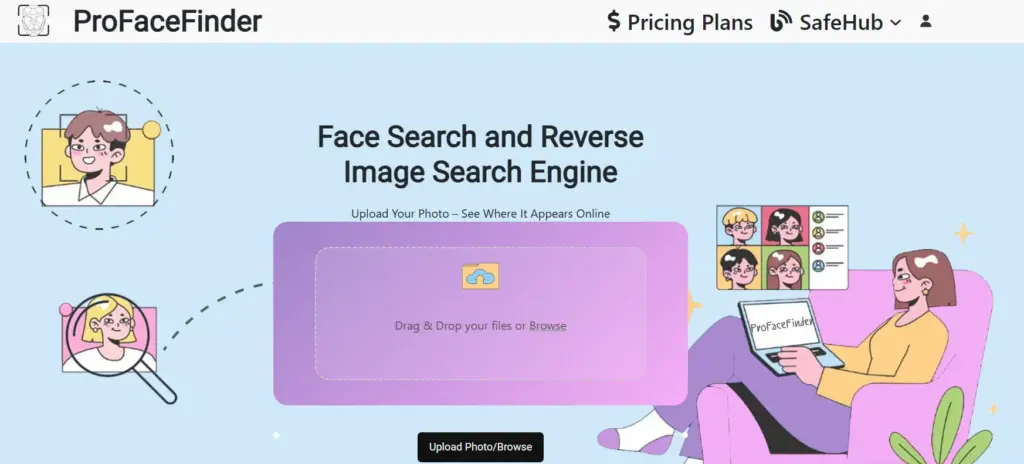
6. ProFaceFinder – The Privacy & Identity Guardian
ProFaceFinder is the top choice in 2026 for users who prioritize their digital privacy. This tool is designed not just to find others, but to help users reclaim their personal images from the internet.

Its privacy-first model and strict ethical guidelines make it the most “Responsible” tool in the industry.
Strategic Advantages
- Impersonation Detection: It specifically targets accounts and profiles using your likeness (face) to operate fake identities or scams.
- Family Security Filters: It features dedicated safety modes to help parents monitor for the online misuse of their children’s photos.
- Ethical Data Handling: It follows strict human-monitored usage policies to prevent stalking and harassment, ensuring it remains a “Clean” tool.
Technical Highlight
The AI uses Synthetic Pattern Detection, which recognizes the subtle differences between real photos and AI-generated deepfakes, making identity theft easier to detect.
Best For
Privacy-Conscious Individuals: To track and remove old or misused photos from the internet.
Families & Professionals: To ensure the digital safety of loved ones and protect against professional impersonation.
The Professional’s Search Protocol (How to Use Effectively)
In 2026, a “random upload” is no longer enough. To get high-accuracy matches from advanced neural networks, you need a structured workflow that prioritizes data quality.
The 4-Step Optimization Workflow
- Step 1: Source Selection: Use “Raw” images whenever possible. AI struggles with heavy filters, “beauty modes,” or AI-upscaled photos that have altered the original pore and bone structure.
- Step 2: The Tight Crop: Manually crop the image to focus strictly on the face. Removing background “noise” (like busy streets or other people) allows the AI to dedicate 100% of its processing power to facial landmarks.
- Step 3: Multi-Engine Triangulation: Never rely on a single tool. Cross-reference results between a “Safety” engine (like FaceCheck.ID) and a “Deep Web” crawler (like PimEyes) to confirm an identity.
- Step 4: Result Verification: Before concluding, check the “Source Link” of the match. Verify if the face appears on a verified social profile, a news article, or an obscure blog to determine the context.
Ethics & Compliance: Navigating the 2026 Landscape
Face search is a “dual-use” technology-powerful for protection, but dangerous if misused. As regulations like the EU AI Act and India’s DPDP Act (Phase 3) tighten, ethical use is no longer optional; it’s a compliance requirement.
The Responsible Search Checklist
- Respect Consent: Use these tools to protect yourself or verify business partners. Avoid using them to de-anonymize individuals who have a reasonable expectation of privacy.
- Avoid Harassment: Using face search for stalking or “doxing” is not only unethical but, in many jurisdictions, a criminal offense with severe penalties in 2026.
- Verify, Don’t Assume: An AI match is a “probability,” not a “fact.” Always treat a match as a lead that requires manual confirmation before taking action.
Strategic Choice: Face Search vs. Reverse Image Search
Many users confuse these two, but for a professional, they serve completely different strategic purposes.
Quick Comparison Table
| Feature | Reverse Image Search (Google/Bing) | Neural Face Search (Lenso/PimEyes) |
| Primary Focus | Objects, backgrounds, and exact file matches. | Specific biometric and skeletal markers. |
| Edited Photos | Often fails if the background is changed. | Works even if the person is in a new environment. |
| Best Use Case | Finding the original source of a meme or product. | Verifying if a person is a real human or a fake. |
The Reality Check: Understanding the Blind Spots
Even the most expensive 2026 AI tools have limitations. Understanding these “Blind Spots” will prevent you from making costly mistakes in your research.
Common Platform Limitations
- The “Private Profile” Wall: No tool can legally crawl private Instagram or Facebook accounts. If a person’s digital life is entirely private, these tools will return zero results.
- The “Look-Alike” Bias: Despite high accuracy, AI can still confuse siblings or people with very similar ethnic features. Always look for unique identifiers like scars or ear shapes.
- Indexing Latency: A photo uploaded to the web today might not show up in a face search for 24–72 hours while the crawlers update their index.
The 2027 Outlook: What’s Next?
We are moving toward a world of Visual Intelligence. Expect to see these trends dominate the next 12 months:
- Real-Time AR Integration: The ability to “search a face” through smart glasses or live video feeds (with strict legal restrictions).
- Synthetic Identity Detection: Tools will get better at flagging “Deepfake” faces that look real but have no mathematical history on the web.
- Blockchain Identity: A move toward “Verified Faces” where people can prove their identity via a secure, un-searchable digital token.
The Final Word
Face search tools are no longer just a “cool trick”-they are a digital literacy skill. Whether you are protecting your own image or verifying the world around you, these tools provide a layer of transparency that didn’t exist a decade ago.
The Golden Rule for 2026: Use multiple platforms, verify every match, and always lead with ethics. In the digital age, your face is your identity—treat it with the respect it deserves.
